B2B Importer's Guide to Prefab Granny Flat Compliance: AS/NZS, CE, and ICC-ES
2026 prefab granny flat compliance guide for B2B importers: AS/NZS, CE, ICC-ES, WaterMark, SAA, supplier checks, RFQs, and approval limits before deposit.
Last Updated: July 2026
Scope and limitations: Global B2B procurement and early engineering guidance for imported prefab granny flat kits, with emphasis on Australia/New Zealand, Europe, the UK, and the United States. This is not legal, certifier, or engineering advice; final compliance depends on the project site, local authority, licensed engineer, plumber, electrician, and current product certificates supplied for that production batch.
Method note: The decision matrix below weights permit rejection, licensed-trade connection risk, destructive retrofit exposure, and documentation traceability. Use it for RFQ triage and supplier qualification before deposit, not as a substitute for stamped local approval.
For B2B buyers, distributors, and procurement teams importing prefab granny flats, navigating the labyrinth of global building compliance is the highest-stakes phase of the supply chain. A single uncertified plumbing fixture or non-compliant electrical wire can result in shipping containers being held at port, catastrophic council approval failures, or expensive on-site retrofit requirements that obliterate your profit margins.
The promise of high-margin modular housing relies heavily on factory efficiency. However, when importing to heavily regulated markets like Australia, New Zealand, the European Union, and the United States, generic claims of "global quality" from overseas manufacturers are insufficient. You need verifiable, component-level certifications.
In this deep-dive guide, we break down the definitive engineering and procurement compliance boundaries for 2026, comparing the AS/NZS (Australia/New Zealand), CE (Europe), and ICC-ES (United States) standards. This guide will equip you to qualify suppliers, specify correct components, and ensure seamless local council approvals.
If you are drafting an RFQ now, map the component list against our compliance pathway, product range, and quote workflow, then contact our B2B procurement team for a document review before deposit.
The True Cost of Non-Compliance
For a distributor, the financial model of importing a granny flat kit works best when local labor is minimized. If an imported unit lacks local compliance, you face the "Retrofit Penalty."
Imagine importing a 40ft expandable granny flat to Sydney. The unit arrives, but the pre-installed plumbing pipes lack the WaterMark certification. Australian regulations dictate that no licensed plumber can legally connect this building to the municipal water supply. Your only option? Tear open the drywall, rip out the non-compliant PEX pipes, replace the fixtures, and rebuild the walls using local labor at $100+/hour. A unit that cost $15,000 FOB suddenly requires $12,000 in local rectification work, entirely negating the cost advantage of offshore manufacturing.
Similarly, structural steel frames without traceable material certificates (like AS/NZS 4600 or EN 1090) will be rejected by local structural engineers, preventing you from obtaining the crucial construction certificate or building permit.
Understanding these boundaries is not just a regulatory hurdle; it is the core of your procurement strategy.
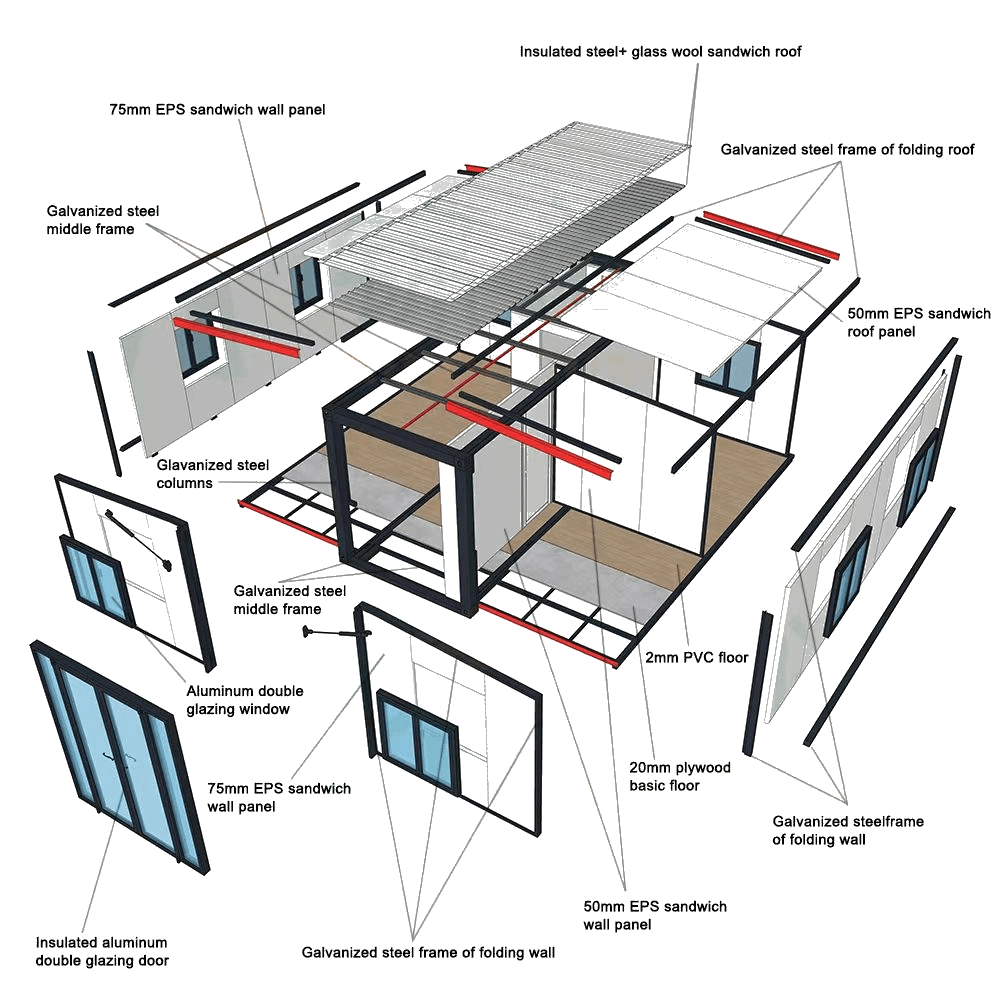
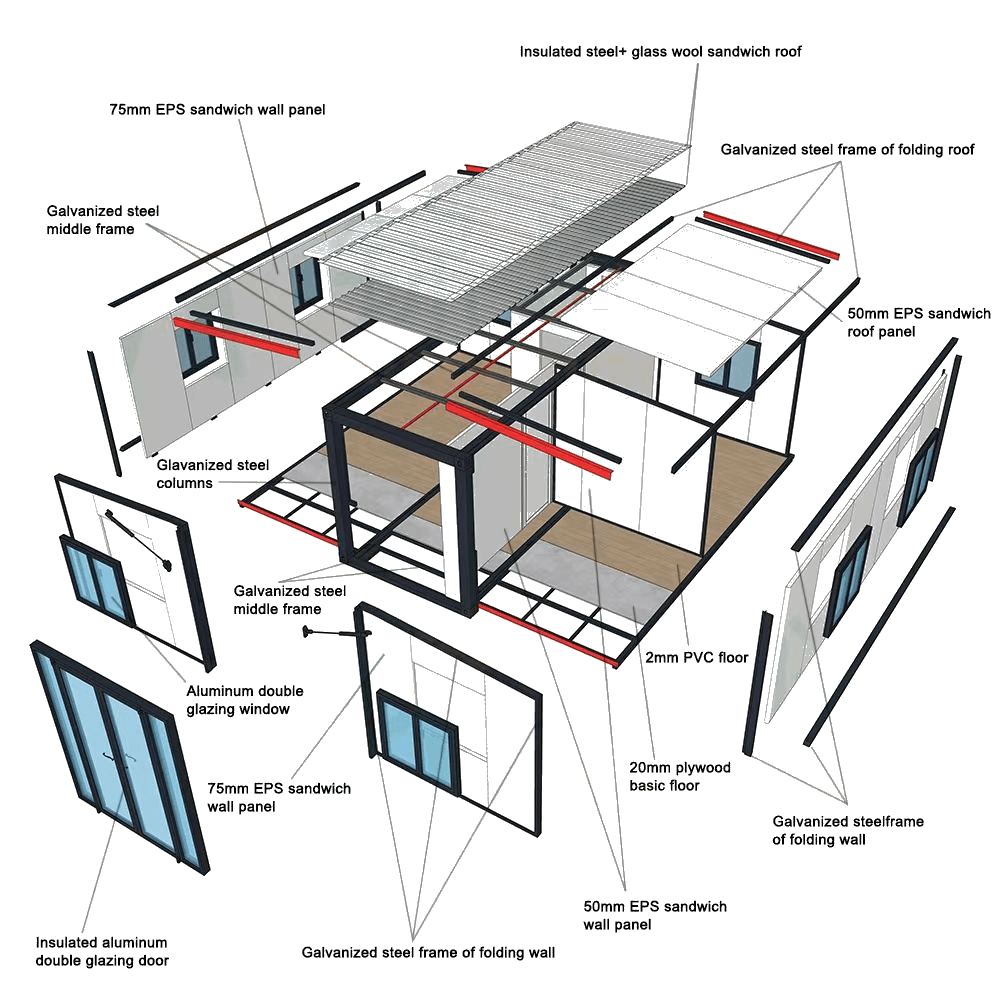
Visualizing Modular Certification Zones
To effectively manage compliance, you must dissect the prefab structure into discrete certification zones. A single "CE mark" on a house does not exist; rather, the components carry the certifications.
Key Standards Breakdown: A Comparative Matrix
Different regions demand vastly different testing criteria. When a factory claims "ISO 9001" (which is merely a quality management standard), it does not mean the product meets local building codes. You must require the specific standards listed below.
| Discipline | Australia / New Zealand (AS/NZS) | Europe (CE / EN) | United States (ICC-ES / IBC) | Risk of Failure |
|---|---|---|---|---|
| Structural Design | AS/NZS 1170.2 (Wind Load N1-C4), AS 4600 (Cold-formed steel) | Eurocodes (EN 1990 - 1999), EN 1090 (Steel Execution) | IBC (International Building Code), ICC-ES AC13/AC86 | Critical: Building will collapse or be denied permit before ground is broken. |
| Plumbing Fixtures | WaterMark Scheme mandatory (AS/NZS 3500) | CE marking for sanitary appliances (EN 997, EN 14688) | UPC (Uniform Plumbing Code) or IPC certified fixtures | High: Local plumbers cannot legally connect uncertified systems. |
| Electrical Wiring | SAA Approval mandatory, AS/NZS 3000 (Wiring Rules) | CE Mark (Low Voltage Directive), RoHS compliance | UL Listed components, NEC (National Electrical Code) | Critical: Severe fire risk, uninsurable, cannot connect to grid. |
| Fire Safety | AS 3959 (Bushfire Attack Level - BAL), AS 1530 | EN 13501 (Fire classification) | ASTM E84, NFPA 285 | Medium-High: Dependent on local zoning, strict in bushfire/wildfire zones. |
| Energy & Glazing | AS 2047 (Windows), NCC Section J (Energy Efficiency) | EN 14351 (Windows and doors), NZEB targets | NFRC rating, IECC (Energy Conservation Code) | Medium: Can cause failure in final occupancy certificate if thermal performance fails. |
| Insulation (Sandwich Panels) | AS 1366 (EPS), AS 1530 (Combustibility) | EN 14509 (Double skin metal faced insulating panels) | ICC-ES AC04 (Sandwich Panels) | High: High scrutiny on EPS panels due to global fire regulations. |
For component-specific follow-up, pair this matrix with our guides to factory pre-plumbed vs on-site plumbing, G550 vs Q235 light-gauge steel, and EPS vs PU vs Rockwool sandwich panels.
The Big Three: Deep Dive into Critical Certifications
1. Plumbing: The WaterMark Bottleneck (Australia specific)
Australia operates one of the strictest plumbing regulatory frameworks globally. The WaterMark Certification Scheme is governed by the Australian Building Codes Board (ABCB). It is a legal requirement that any plumbing or drainage product intended for installation in Australia must be WaterMark certified.
- The Pitfall: Factories will often use generic PVC pipes and standard taps that look fine but lack the WaterMark stamp and registration number.
- The Solution: If you are a B2B distributor, you must demand that the manufacturer uses only WaterMark-certified PEX piping, floor drains, shower heads, toilets, and valves. Alternatively, you can request the unit to be shipped as a "bare shell" (plumbing omitted) and have a local contractor rough-in the plumbing, though this reduces the prefabricated value.
2. Electrical: SAA vs. UL vs. CE
Electrical compliance is primarily about fire safety and grid compatibility.
- Australia (SAA): Electrical components must have SAA approval. Furthermore, the actual wiring installation must comply with AS/NZS 3000. Because wiring is hidden within the SIPs or steel frame panels, Australian authorities often require an inspection during manufacture. Many B2B buyers opt to have corrugated conduits pre-installed in the factory, allowing the local Australian electrician to simply "pull" the SAA-approved wires through the walls on site.
- Europe (CE): Requires compliance with the Low Voltage Directive (LVD) and Electromagnetic Compatibility (EMC) Directive.
- USA (UL): Every switch, wire, and breaker box must be UL listed.
3. Structural Integrity: Wind, Snow, and Seismic
For granny flats, the structural frame (usually Light Gauge Steel - LGS) must withstand local environmental extremes.
- Wind Ratings: In Australia, homes in cyclonic zones (like North Queensland) require C3 or C4 ratings, necessitating significantly thicker steel profiles (e.g., G550 steel, >1.0mm thickness) and enhanced bracket tie-downs. Standard factory models usually only meet N1 or N2 (non-cyclonic).
- Material Traceability: You must receive Mill Test Certificates from the factory proving the steel grade (e.g., Q235, Q345, or G550) and the galvanization thickness (e.g., Z275) to satisfy local structural engineers.
 A typical Light Gauge Steel (LGS) frame for a 20ft modular unit. Notice the cross-bracing and welded joints—these must be signed off by a certified engineer according to your local code.
2026 B2B Importer's Qualification Checklist
Procurement teams must shift from asking "Is your product good quality?" to "Can you prove your compliance framework?" Use this checklist when negotiating with a new OEM supplier.
- 1. Request the Registration Numbers: Do not accept a PDF certificate alone. Ask for the WaterMark license number, SAA certificate number, or ICC-ES report number, and verify them independently on the official databases.
- 2. Define the 'Pre-installed' Scope: Explicitly define in the Purchase Order whether electrical wiring and plumbing will be pre-installed or if the factory will only provide empty conduits.
- 3. Demand Mill Test Certificates: Before paying the final balance, ensure you have the chemical composition and yield strength certificates for the LGS framing.
- 4. Third-Party Factory Inspection: Hire an independent QA inspector (e.g., SGS, TÜV, or a specialized engineering firm) to audit the factory during the wall-closing phase. Once the walls are sealed, inspectors cannot verify the internal wiring or insulation density.
- 5. Confirm Insulation Combustibility: If using EPS (Expanded Polystyrene) sandwich panels, ensure they contain flame retardants that pass local fire tests (e.g., AS 1530.3 or EN 13501), or upgrade to Rockwool/PU for guaranteed compliance in strict zones.
- 6. Window Glazing Certifications: Verify that windows carry the required AS 2047 standard (AU) or NFRC label (US), with toughened glass used in wet areas and doors.
FAQ: Navigating Compliance Obstacles
Q: The manufacturer says their product is "ISO 9001 Certified". Is this enough to import? A: No. ISO 9001 only means the factory has a documented quality management system (like standardizing how they handle customer complaints or trace inventory). It has absolutely nothing to do with whether the physical building meets your local building codes, structural wind loads, or electrical safety standards.
Q: Can I import a granny flat without WaterMark plumbing and fix it later? A: Yes, but it is highly inefficient. If you import a fully finished unit with non-compliant plumbing, you must destructively remove the walls and floors to rip out the illegal plumbing, then pay local tradesmen premium rates to reinstall it. It is vastly superior to import a "dry shell" and do the fit-out locally if the factory cannot supply WaterMark components.
Q: How does a local council approve a building manufactured overseas? A: In most developed nations, the council relies on independent engineering sign-offs. You will need a local structural engineer to review the factory's shop drawings and steel certificates to issue a compliance certificate (e.g., a Form 15 in Queensland, Australia). The local electrician and plumber will sign off on their respective installations on-site.
Q: Does CE Marking allow me to sell in the UK post-Brexit? A: Treat UK projects as a separate compliance check rather than assuming EU CE acceptance is enough. UKCA and CE recognition rules for construction products have changed repeatedly, so B2B importers should verify current GOV.UK guidance, confirm the required mark for the exact product category, and require suppliers to provide UK-ready technical files before production.
Strategic Recommendations for 2026
The global market for prefab housing is evolving rapidly. Regulatory bodies are becoming stricter regarding energy efficiency (e.g., Australia's transition to 7-star energy ratings) and fire resistance. Importers who build a robust, verified compliance pipeline will outcompete those who chase the absolute lowest FOB price.
When you purchase a Granny Flat Kit, you are not just buying steel, panels, and glass—you are buying the documentation and engineering certainty that makes the structure legal to inhabit.
Ready to source compliant, high-quality modular housing?
Our engineering team specializes in adapting our manufacturing processes to meet strict AS/NZS, CE, and US standards. Whether you need a standard flat-pack or a custom expandable design, we provide the documentation you need for a smooth approval process. Contact our B2B procurement team today to discuss your compliance requirements and request technical specifications.
References and Verifiable Sources
- Australian Building Codes Board (ABCB) - WaterMark Certification: The mandatory national scheme for plumbing and drainage products. ABCB WaterMark Official Guidelines
- European Commission - CE Marking for Construction Products (CPR): Regulation (EU) No 305/2011 laying down harmonised conditions for the marketing of construction products. European Commission CPR Data
- ICC Evaluation Service (ICC-ES): The industry leader in performing technical evaluations of building products, materials and systems for code compliance in the United States. ICC-ES Evaluation Reports
- Standards Australia - AS/NZS 1170.2 (Wind Actions): Structural design actions for wind loads on structures. Standards Australia
- GOV.UK - Construction Products Regulation in Great Britain: Current UK government guidance for construction product marking and placing products on the GB market. Construction products regulation in Great Britain
Author

Categories
More Posts

Light Gauge Steel (LGS) in Prefab Granny Flats: G550 vs Q235 Procurement Guide 2026
Discover the critical differences between G550 high-tensile steel and Q235 mild steel in prefab granny flats. Learn how to verify yield strength and coatings.
NSW Granny Flat Approval Pathways: CDC vs DA (2026)
NSW granny flat approval pathways explained (2026): CDC vs DA, when each applies, and how to assess your property's approval route before buying a granny flat kit. Covers granny flat rules NSW, setbacks, and council vs certifier paths.
Australia Modular & Granny Flat Market Update (W20 2026)
Australia W20 2026 update on granny flat kits: secondary dwelling approvals, state planning shifts, and delivery economics, with actions before you commit.